Stakeholders of Rural Growth
A shared analytical framework and standardised dataset for mapping and categorising key actors relevant to rural Entrepreneurship & Innovation (E&I) education.
Work Package
WP3 – Preparing Local Leadership Stakeholder Toolkit
Purpose
Strengthen stakeholder-informed rural E&I education and curricula
Method
Comparative analysis across 4 partner institutions
Status
Final version – February 2026
Deliverable D3.04
Stakeholders of Rural Growth
Effective education for rural entrepreneurship and innovation cannot rely on academic knowledge alone. It also needs strong connections with the people and organisations that understand rural territories, their challenges and opportunities.
The D3.04 Stakeholders of Rural Growth deliverable maps and analyses the key stakeholders who can contribute to entrepreneurship and innovation education across the ENGINE partner regions. The result is a shared stakeholder framework and database designed to help universities systematically connect students with real-world expertise, experience and local development ecosystems.
What does the deliverable provide?
The analysis brings together stakeholder ecosystems identified by four ENGINE partner universities:
- Krakow University of Economics – Poland
- University of Foggia – Italy
- Polytechnic Institute of Viana do Castelo – Portugal
- FH Münster – University of Applied Sciences – Germany
Stakeholders were identified and assessed using a common methodology developed in D3.01. The analysis considered 10 criteria, covering their sector, role in education, level of involvement, geographical reach, rural expertise, experience in local development and ability to work across different sectors.
What did the analysis reveal?
The comparison of the four partner regions showed a strong convergence in the types of stakeholders relevant to rural entrepreneurship and innovation education. At least 6 of the 10 assessment dimensions demonstrated a high level of standardisation across the partner institutions, while regional differences reflected the specific socio-economic characteristics of each territory.
The analysis also highlighted three particularly important characteristics of effective stakeholders:
- practical expertise in rural entrepreneurship, innovation and local development;
- strong territorial embeddedness and knowledge of local socio-economic and cultural conditions;
- cross-sector capacity – the ability to connect universities, businesses, public authorities and communities.
From stakeholder mapping to education
One of the most important outcomes of D3.04 is the Standardised Stakeholders of Rural Growth Framework. It translates the findings from regional stakeholder databases into a common structure that can guide universities in identifying and engaging external experts.
The framework connects stakeholder expertise with:
- stakeholder sector
- thematic area
- educational role
- EDUPACK content
- student competences
This means that stakeholders can contribute not only as guest speakers, but also as mentors, internship providers, case-study contributors, challenge providers, content co-creators, advisors and project partners.
From knowledge to action
The Stakeholders of Rural Growth framework helps move rural entrepreneurship education beyond the classroom — connecting academic learning with local businesses, public institutions, communities and innovation ecosystems.
The result is a more practical, connected and territorially relevant approach to educating the future leaders of rural development.
What's inside?
1. Comparative analysis
Comprehensive review of rural E&I stakeholders across four countries and institutional contexts.
2. Synthesis of findings
Comparison of stakeholder classification across 10 dimensions and identification of common patterns and contextual nuances.
3. Competencies in rural E&I
Analysis of stakeholder competencies and experience relevant to rural entrepreneurship education and local/regional development.
4. Standardised framework
A coherent Stakeholders of Rural Growth framework that harmonises stakeholder types, roles and competencies for cross-partner use.
Key results and benefits
A harmonised catalogue of rural E&I stakeholders across Poland, Portugal, Italy and Germany.
A standardised classification of stakeholders based on 10 key criteria (type, role, involvement, scope, engagement, competencies, experience, affiliations, cross-sector potential, current/future link).
Clear mapping of stakeholder competencies and experience aligned with the academic content plan (D3.02) and the academic profile of rural entrepreneur (D3.03).
A robust foundation for designing educational modules, learning activities and materials in the EDUPACK tool (WP4).
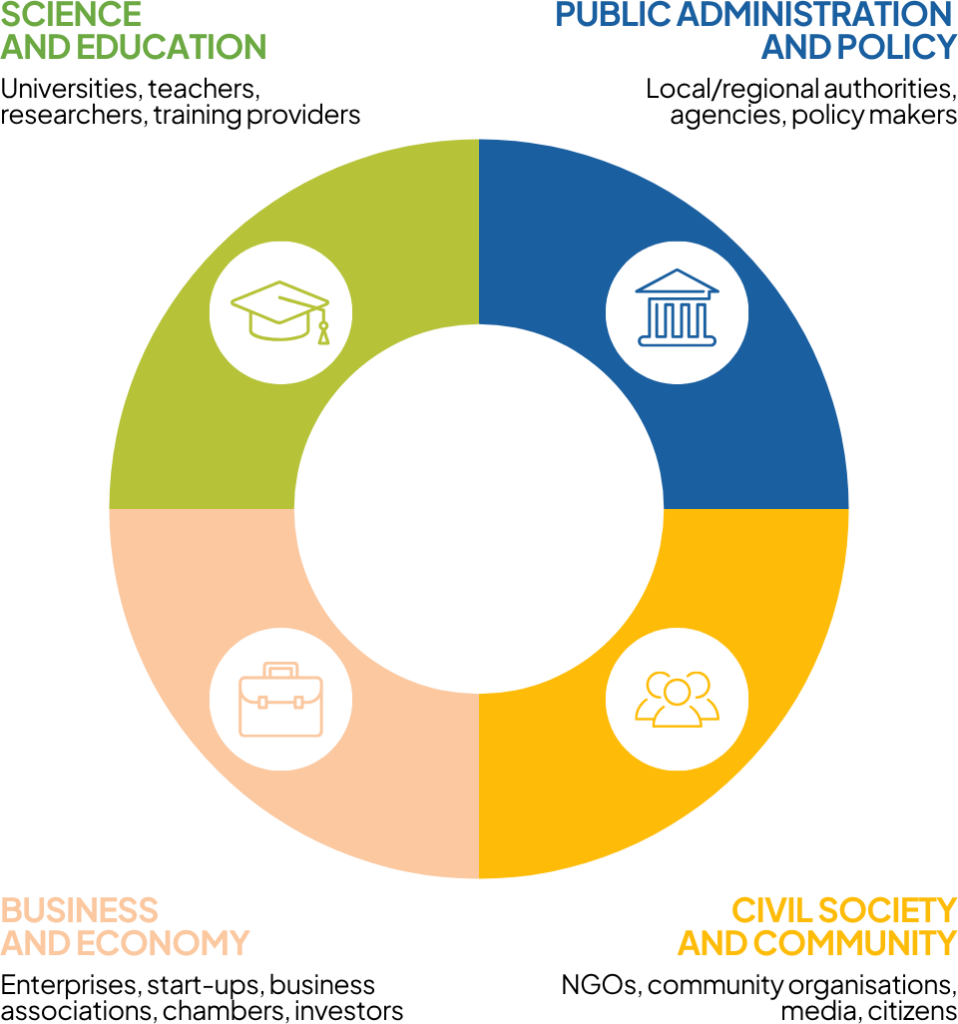
A Quadruple Helix approach
The stakeholder landscape is organised according to four complementary sectors:
OUR TEAM
Meet the partners of ENGINE