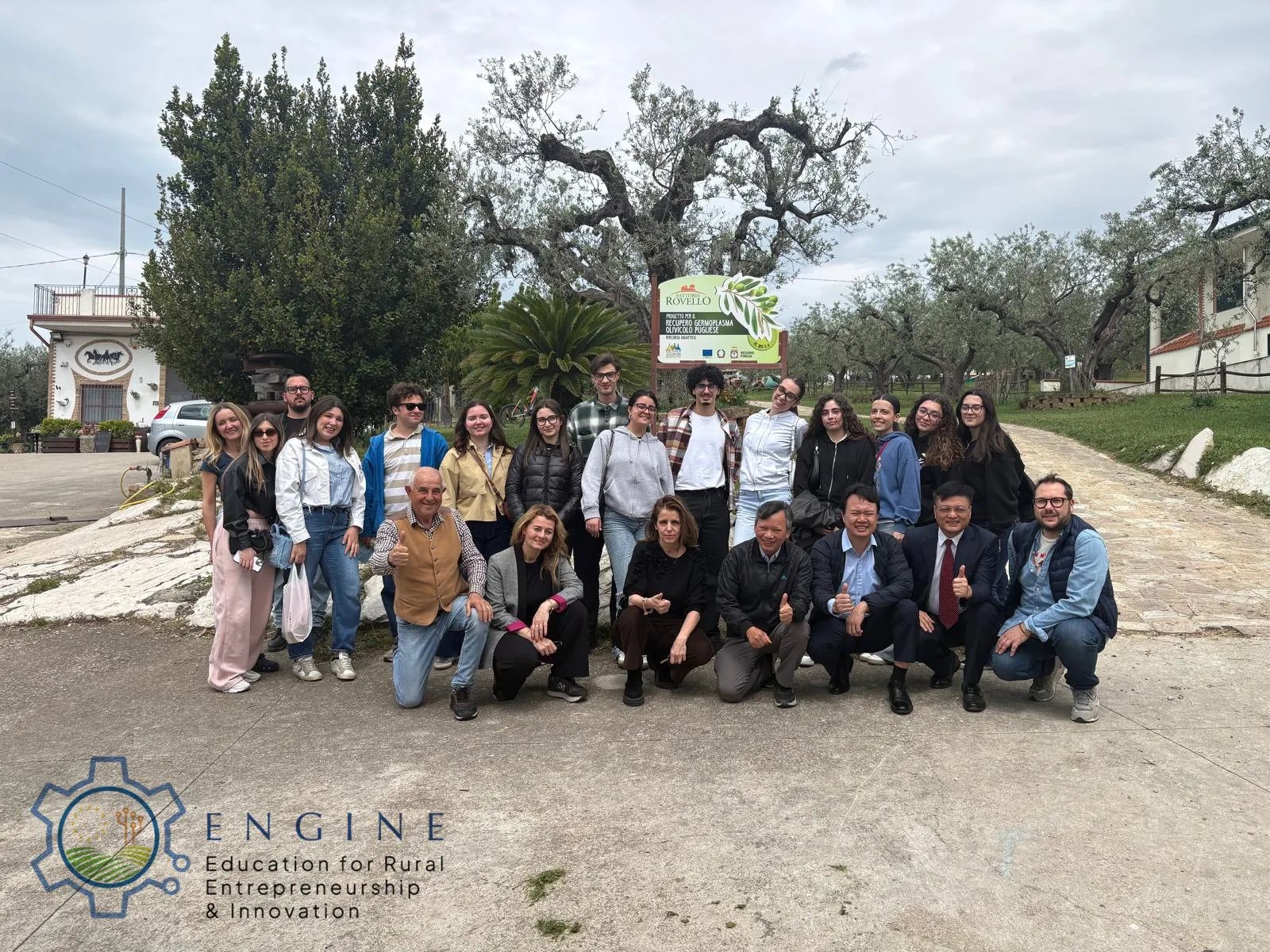


On 6 May 2026, Fattoria Rovello, an educational farm in the Foggia province, provided the setting for an outdoor educational experience built on the synergy between Italy’s NRRP-funded project GPSeducation, aimed at strengthening international university cooperation through education and research on sustainability, and the Erasmus+ ENGINE project, dedicated to boosting rural development by fostering entrepreneurship and innovation.
The event brought together students and faculty from the complementary course Social Farms: New Tools for Wellbeing and Learning for Economic Innovation (Prof. Assunta di Matteo), offered within Prof. Mariantonietta Fiore’s bachelor’s course on Civil Economics, Integral Ecology, and Sustainable Development, alongside four Vietnamese visiting professors from Hanoi University and Phenikaa University, participating in the GPSeducation project at the Department of Economics, University of Foggia.
Fattoria Rovello proved an ideal setting to bring ENGINE’s themes to life, engaging the rural stakeholders it seeks to reach. Participants explored the role of educational farms as instruments of inclusion, wellbeing, and place-based learning. The farm’s museum of rural civilisation stood out for its collection of traditional agricultural tools, which prompted a spontaneous and meaningful intercultural dialogue, as the Vietnamese guests noted numerous parallels between the artefacts on display and those still in use in rural areas of Vietnam, a reminder that agricultural heritage can be a powerful bridge across cultures.
The Vietnamese academic team delivered an open-air lecture on rural development and social innovation in their own territorial context, enriching the discussion with comparative perspectives across two distinct rural realities. The educational farm itself exemplifies the social entrepreneurship model, carrying out pet therapy interventions for children and residents of a nearby nursing home, demonstrating how agricultural enterprises and community welfare functions can be integrated. The presence of three kindergarten classes added a further dimension to the day, underlining the intergenerational and inclusive potential of outdoor learning environments.